
Stop Calling Every Photo a Headshot: Understanding Corporate Imagery
- Pierre R Michel
- Feb 17
- 6 min read

Updated: May 27
Quick Navigation
The Real Problem Is Not Photography
The Cost of Getting This Wrong
Why Quick, Cheap Headshots Cost More in the Long Run
The Corporate Imagery Standards Most Teams Ignore
What Strong Brands Do Differently
The Line in the Sand
What to Do Before You Book
Frequently Asked Questions
The Real Problem Is Not Photography
Most corporate teams do not have a photography problem. They have a clarity problem. They say, “We need headshots.” But what they actually need is visual alignment.
Some teams want standardized executive portraits. Others seek brand storytelling images. Some desire a cultural refresh that reflects growth. Yet everything gets labeled with the same term: Headshot.
When terminology is vague, expectations become unclear. When expectations are unclear, results can feel underwhelming. When results feel underwhelming, companies often assume they chose the wrong photographer. In reality, they started with the wrong objective.
Misusing headshot terminology is not a small mistake. It is the first step in diluting your brand before the camera even comes out.
The Cost of Getting This Wrong
When teams treat every professional image as interchangeable, the damage is subtle but real. You see it on company websites across Atlanta every day. Leadership pages often feature five different lighting styles, cropped inconsistently. Some images are tightly framed, while others are wide. Some are heavily retouched, while others remain untouched.
That is not personality. That is inconsistency. Inconsistency signals a lack of control. For corporate brands, perception is leverage. If your visual presentation feels scattered, your authority weakens. This happens not because the photos are bad, but because they are misaligned.
The difference between a strong brand presence and a forgettable one often starts with understanding the difference between a headshot and a branding portrait. This is not just semantics; it is strategy.
Why Quick, Cheap Headshots Cost More in the Long Run
There is nothing wrong with efficiency. However, cutting corners on brand assets can be detrimental. Many companies book fast, low-cost sessions because they believe all they need is “a photo.” They receive one cropped file and move on.
Then reality hits. Marketing needs a horizontal crop for the website banner. LinkedIn compresses the image awkwardly because the face is framed too wide. The design team requires a transparent background for a proposal deck. HR wants uniform formatting for internal communications.
Now someone is resizing, re-cropping, and attempting background removal in design software. What felt inexpensive becomes fragmented. The issue was never about price; it was about a lack of foresight.
A professional headshot should function across platforms for years. It should support marketing, recruitment, media features, and internal branding. That is why at Headshot Solutions & Beyond in Atlanta, we do not deliver a single image and call it complete.
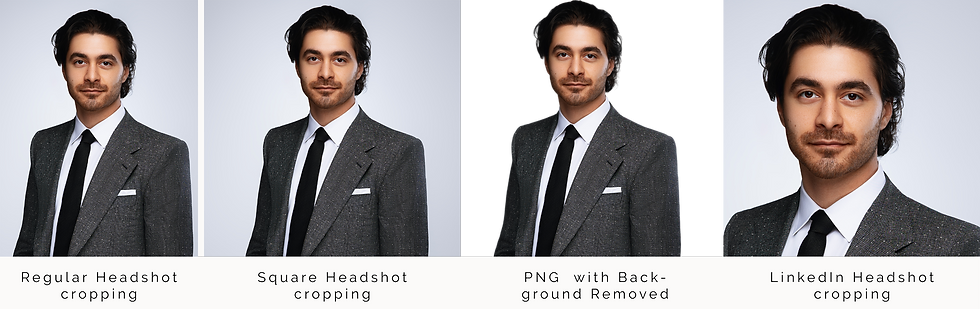
Every final headshot includes three intentional files:
A standard professional crop for websites, press features, and company bios.
A LinkedIn-optimized crop that frames roughly 60 percent of the face for maximum clarity inside the circular profile format.
A PNG version with the background removed so your design team can integrate the image seamlessly into proposals, campaigns, and branded graphics.
That is not an add-on. That is infrastructure. Headshots are not content; they are brand assets. If your photographer is not thinking beyond the session, you are paying for a moment instead of investing in leverage.
The Corporate Imagery Standards Most Teams Ignore
A Strategic Approach to Headshot Terminology
Let’s draw the distinctions clearly—not to sound technical, but to protect your brand.
Headshot

A true corporate headshot is controlled, standardized, and intentional. It is typically framed from the chest or shoulders up. The lighting is consistent across the team. The background is deliberate. The tone aligns with company positioning. Its job is simple: establish credibility quickly.
A headshot is not experimental; it is not a lifestyle image. It is not a casual snapshot taken near a window. If half your team has bright white backgrounds and the other half has textured gray, you do not have brand cohesion. You have visual noise.
3/4 Shot

A 3/4 shot frames the subject from the head to mid-thigh or above the knees. It allows posture and body language to play a larger role. This format introduces personality while maintaining professionalism. It works well for founders, executives, and client-facing professionals who need authority with warmth.
But it must be intentional. Mixing tight headshots with wide 3/4 shots on the same leadership page disrupts visual hierarchy. Strong brands choose one direction and apply it consistently.
Branding Portrait

This is where most confusion resides. A branding portrait is not simply a photo taken outside the studio. It is a strategic image built around context. Environment, wardrobe, lighting, and composition work together to reinforce positioning. A law firm photographed in a polished office communicates stability. A tech founder photographed in a dynamic workspace communicates innovation.
Branding portraits answer a different question than headshots. Headshots ask: Can I trust you? Branding portraits ask: What are you known for? If you cannot answer that question before booking your session, you are not ready to choose the format.
Natural Light vs. Studio Lighting
This decision is about control. Natural light feels organic and warm. It works well for lifestyle-driven brands or personal branding sessions. Studio lighting delivers precision and repeatability. For corporate headshots in Atlanta, where team growth is ongoing, consistency matters. New hires should match existing visuals seamlessly.
If your company is scaling, controlled lighting protects brand continuity. That is strategic.

Retouching
Retouching should refine, not reinvent. Professional retouching removes distractions while preserving authenticity. Over-retouching erodes trust. Under-retouching feels careless. The standard is simple: you should look like yourself on your best, well-rested day.
Consistency across the team matters here as well. If executives are polished and staff are minimally edited, that imbalance is visible.
Composition, Cropping, and Depth of Field
These choices shape perception. A tight crop communicates confidence and authority. A wider crop introduces openness. A shallow depth of field isolates focus. A deeper depth of field introduces context. When these decisions are random, the message becomes diluted. When they are intentional, the brand feels controlled.
What Strong Brands Do Differently
Strong brands do not begin with “We need headshots.” They begin with clarity. They define:
Where the images will live
Who the audience is
What perception they want reinforced
How consistency will be maintained over time
Then they choose the format. That is the difference between companies that “have photos” and companies that use imagery as leverage. In a competitive market like Atlanta, where corporate presence matters, visual consistency is not optional. It is foundational.
The Line in the Sand
At Headshot Solutions & Beyond, we do not treat corporate photography as a task to check off during a rebrand. It is brand infrastructure. If a team cannot articulate whether they need standardized headshots or strategic branding portraits, we slow the process down. Because once the camera comes out, the positioning should already be defined.
Every image published under your company’s name reinforces something. The question is whether it reinforces the right thing.
What to Do Before You Book
Before scheduling your next session, answer three questions:
Are we building trust, showcasing culture, or repositioning our brand?
Do we need consistency across a growing team?
Where will these images be used over the next 12 to 24 months?
If those answers are unclear, pause. Clarity first. Camera second.
Work With a Studio That Treats Imagery as Infrastructure
If you are investing in corporate headshots in Atlanta, stop starting with “We need photos.” Start with strategy. At Headshot Solutions & Beyond, we help companies define the right visual direction before the session begins. The result is not just a set of images; it is alignment.
If that is the standard you are looking for, book a strategy conversation at hsbatl.com or reach out directly at info@hsbatl.com.
Frequently Asked Questions
1. Are headshots really that important for internal teams?
Yes. These images appear in Slack, email signatures, proposals, recruiting materials, and internal platforms. Inconsistent imagery signals disorganization. Consistency signals leadership.
2. How often should corporate headshots be updated?
Every 2–3 years is a strong standard. Update sooner if leadership changes, brand positioning shifts, or the images no longer reflect how your team presents itself today.
3. What role does retouching play in professional headshots?
Retouching should refine, not distort. Remove temporary distractions while preserving character. When editing is obvious, credibility drops.
4. How should marketing and HR think about headshot delivery?
As infrastructure. Files should be delivered in multiple crops and formats so they work across platforms without additional edits. If resizing becomes a recurring task, the process was flawed.
Your brand deserves more than a photo.
It deserves intention.


Comments